Thursday, September 13, 2018

Crispy Chicken Tenders with Honey Mustard Sauce


Being at the ocean as well as near the mountains are equally and simultaneously the most energizing and calming places for me. They are what I affectionately call my happy places. Having recently returned home from spending time at one of my most happiest places, I am still feeling its' unexplainable effects. As one of my friends said 'why don't you move there?' Who knows, I said, maybe someday I will. After spending some time near the ocean, I now feel the mountains calling. Seems my soul is drawn to both compelling landscapes and it would be almost impossible to choose between the two.

With my camera in tow, I went back to some of my favorite familiar places as well as took drives on unfamiliar roads while on this 'happy birthday to me' trip. Although I had been wishing for perfect cloud filled, blue sky days to serve as the backdrop for my photos, the mists and gray skies proved to capture images even more beautiful than I could have ever imagined. From the wine vineyard, to the apple orchard, to the farms, to the harbor, to the flowers clinging to stone walls and iron fences, to the dahlia garden of ninety something year old woman, my eyes were mesmerized by and heart was racing from being able to take in all of the extraordinary ordinary beauty before me.

In addition to the time spent wandering around taking photos, I was able to spend some quality time with some of the people I love in the place that I love. One of the best, unexpected surprises of this trip was having a glass of wine with fellow 'food photographer and recipe sharer' in a charming unbeknownst to me local tavern. Prior to my trip out east I reached out to her on Instagram and asked if she would like to meet to talk about food and photography (I have been awestruck by her posted photos). Not only did she introduce me to one of the local establishments, she unselfishly shared some of her photography techniques and tools. If only I had a cellar where diffuse light came in through the window! While our life paths were completely different, we had many similar interests. Which ended up making it feel as if I had met an 'old' new friend. If I hadn't already had dinner plans with another friend, I think we could have talked for hours more. Have you ever experienced an immediate connection with someone you meet for the first time?


Speaking of first times, I can't believe it has taken me this long to make these Crispy Chicken Tenders with Honey Mustard Sauce. As someone who has eaten more than their fair share of chicken fingers (albeit the fast food version), I should have started making them years ago. Maybe it was because I was under the (wrong) impression that the best chicken tenders were deep fried. But like most deep fried foods, there can be an equally, maybe even better, baked version. And these chicken tenders go into the better version category. With the weather starting to turn cooler and the fall entertaining season beginning, there couldn't be a better time of the year to begin making them. Trust me, you will still want to turn on the oven when the warmer temperatures return.

Who knew making Crispy Chicken Tenders with Honey Mustard Sauce could be so easy? Apparently many people as there are a significant number of baked chicken tender recipes out there. Some use panko crumbs and some use crushed corn flakes. I went with corn flake route. Most of the recipes begin with marinating skinless strips of chicken breasts in a buttermilk mixture for varying lengths of time. Smoked paprika and hot sauce are blended in with the buttermilk and marinating time ranges from four (4) hours to overnight (longer is sometimes better). 


The first time I made them I placed the cornflake coated chicken tenders directly on a parchment paper lined baking sheet. The second time, I put them on top of a wire rack sitting in a baking sheet. They were crispier the second time around as the air in the oven circulated around the 'elevated' chicken tenders. In spite of turning the placed directly on the parchment paper lined baking sheet chicken tenders after 12-14 minutes of baking, they didn't crisp up as much due to being affected by steam.


When I served these sinfully delicious Crispy Chicken Tenders I served them with a honey mustard sauce and a BBQ sauce. The three ingredient honey mustard sauce disappeared. 


Whether served as a hearty appetizer or main course, these Crispy Chicken Tenders with Honey Mustard Sauce are certain to be a huge hit with both kids and adults! After you taste these, I am willing to bet you won't ever make those 'store-bought, frozen' chicken tenders again. 


These flavorful moist on the inside, crispy on the outside chicken tenders should make an appearance on everyone's table at least once in the weeks ahead. But who knows, they might begin making regular appearances on weekly game days or weeknight dinners!

Recipe
Crispy Chicken Tenders with Honey Mustard Sauce (inspired by multiple sources)

Ingredients
Chicken Tenders
1 1/2 cups buttermilk
3 large skinless, boneless chicken breasts (approximately 2 pounds), cut into strips 1 inch strips about 1/2 inch thick
2 teaspoons hot sauce
1 1/2 teaspoons smoked paprika, divided
4 cups (4 1/2 ounces) corn flakes, crushed 
1/2 teaspoon onion powder
1/2 teaspoon kosher salt
1/4 teaspoon garlic powder
1/2 teaspoon black pepper
Optional: Freshly chopped parsley and Flaky Sea Salt

Honey Mustard Sauce
3 tablespoons dijon mustard (recommend Maille)
1/4 cup honey
1/4 cup mayonnaise

Directions
Chicken Tenders
1. In small bowl, combine the buttermilk, hot sauce, and 1/2 teaspoon of the smoked paprika. Set aside.
2. Place chicken strips in a large ziplock bag. Pour in the buttermilk mixture. Refrigerate for 4 hours or overnight.
3. Crush the corn flakes into panko-like sized crumbs using either a food processor or putting in a ziplock bag and crushing with a rolling pin. Pour into a medium sized bowl.
4. Mix in the remaining 1 teaspoon of smoked paprika, onion powder, garlic powder, salt, and pepper to the crushed cornflakes.
5. Line a baking sheet with aluminum foil and place a cooling rack on top. Set aside. 
6. Preheat oven to 400 degrees (F).
7. Remove chicken strips one at a time and press into the cornflake mixture until well coated. Place each chicken strip on top of the cooling rack.
8. Bake chicken strips for 12-14 minutes. Then flip over each chicken strip and continue baking for another 12-14 minutes. Allow to rest several minutes.
9. Transfer to a large platter. Sprinkle with chopped parsley and sea salt. Serve with the honey mustard sauce.

Honey Mustard Sauce
1. Combine all ingredients in a small bowl. Whisk together and well blended. Serve.

Notes: (1) In addition or in lieu of serving with the Honey Mustard Sauce, could also serve with Ranch Dressing or BBQ sauce. (2) Recommend doubling the Honey Mustard Sauce recipe! (3) I marinated the chicken tenders overnight, but let them marinated for at least 4 hours before baking them.


Along a country road in Westport, Massachusetts (September 2018)


Wednesday, August 29, 2018

Scotcheroos 2.0


Last weekend I made pizza on the grill for the first time this summer. I know, that's crazy, right? Hours before I shared what the plan for dinner would be did I learn my pizza stone had somehow managed to get broken. Apparently it broke all on it's own. Now that's even crazier, right? In a rare 'just go buy a new one' comment from the person who shall remain nameless, I didn't waste the opportunity. It just so happened we were near Williams-Sonoma at the time (there is one less than 4 miles from my house). Rather than get the same 'magically breaks on its' own' one I had before, I decided to go big this time and get an Emile Henry pizza stone. Ever since I first saw one, I had wanted it but couldn't bring myself to indulging myself into buying something really nice versus need to have. So having now made a somewhat sizable investment (relatively speaking) investment in a great new pizza stone, I feel like homemade pizza on the grill (or in the oven) should start becoming a regular thing around here. This would be my irrational way of justifying the cost way of thinking. With tomatoes still in season, the simple fresh tomato, mozzarella, fresh herb, garlic, pesto, drizzled with olive oil pizza made on new pizza stone on the grill turned out to be amazing! And hunger had absolutely nothing to do with the collective opinion on the taste or texture of the pizza. It really was crazy good. So this week I am having some of my friends and am, guess what? I am making pizza on the grill! Fingers crossed the second pizza is as good as or better than the first one! Because I always like to have something sweet or a dessert to serve when I have people over, I decided I would make the Scotcheroos 2.0 too. Considering one of my friends is from the land of hot dish and Scotcheroos (aka Minnesota) the timing for making them was perfect. Being able to have someone re-connect with a childhood memory gives me a certain kind of thrill.


Scotcheroos have been described as a Rice Krispie Bar on steroids. Bordering closer to a candy bar than a dessert bar, a recipe for Scotcheroos was originally printed on a box of Rice Krispies cereal back in the 1960s. Today, they evoke a kind of nostalgic experience for those us growing up with them. Peanut butter, butterscotch, and chocolate combined with Rice Krispies (or other crisped rice cereal) create a melt-in-your-mouth kind of lusciousness not found in any other 'cereal' bar confection. Midwesterners may have a special affinity for Scotcheroos, however, they have found their way into kitchens across the country for past fifty plus years. If for some reason, Scotcheroos never made it to your neck of the woods, you have been missing out. No-bake Scotcheroos generally start making their appearance at pot-lucks, family gatherings, and afternoon snack trays in the fall, when the weather begins to cool. 

The original recipe for Scotcheroos were made with just six ingredients: granulated sugar, peanut butter, corn syrup, Rice Krispies cereal, semi-sweet chocolate chips, and butterscotch chips. Over the past fifty years, multiple variations of this beloved bar have emerged. The most common one replaces semi-sweet chocolate chips with milk chocolate chips. However, it wasn't until I stumbled across Sarah Kieffer's Scotcheroos recipe did I learn light brown sugar is a great replacement for granulated sugar; vanilla and salt are great flavor boosters; and, butterscotch chips should be melted into the peanut butter rather than in the semi-sweet chocolate for a more epic Scotcheroo! The ingredient alterations in this Scotcheroos recipe, which I am affectionately calling Scotcheroos 2.0, are not only genius, they take this classic bar to a whole new level of addictive oh-em-gee deliciousness. 


Measuring out all of the ingredients before you begin making the Scotcheroos makes the process go smoothly and easily. And using a large, heavy bottomed pan makes this one-pot wonder a breeze to assemble. 


Not only does brown sugar bring a deeper flavor to these Scotcheroos, melting the butterscotch chips in with the peanut butter surprisingly brings some balance to all of the sweetness in the bars bottom layer. After bringing the brown sugar, corn syrup, and salt to a boil, the pan is removed from the heat. Working quickly the peanut butter and butterscotch chips are stirred into the hot mixture until everything has melted. After a quick stir in of the vanilla, the already measured out Rice Krispies are added in. As with making Rice Krispie treats, you will get a bit of an upper arm workout getting everything evenly mixed together before transferring to your prepared pan.


For the record, I am HUGE fan of lining all of my baking pans with parchment paper. More often than not I am dismissive of most recipes calling for lightly buttering a pan, choosing instead to use the 'makes removal from the pan a cinch' parchment paper. Being able to lift a pan of brownies or Scotcheroos out of the pan without incident is one of those little things in life making me happy.


Melted semi-sweet chocolate topped this pan of Scotcheroos although I gave some thought to topping it with a combination of melted milk and semi-sweet chocolate. While I am still tinkering with the idea of combining those two chocolates, I would definitely recommend lightly sprinkling the semi-sweet chocolate layer with flaky sea salt. To prevent the sea salt from melting into the warm/hot chocolate, wait at least 7-9 minutes to sprinkle it on (the chocolate will not have set up by then but will have started to cool down). 


To keep as much as the chocolate's shine as possible, I did not put the pan of Scotcheroos in the refrigerator to speed up the setting up process. 

Decadent and rich are two words one might also use when describing Scotheroos. So when you cut them into bars or squares, think smaller rather rather than larger. It was only after I cut the pan into two inch squares that I had 'ah-ha' moment. 


I made several changes to Sarah's recipe. I used 6 1/2 cups of Rice Krispies cereal instead of 6 cups because the mixture seemed to call for it; used slightly more than a pound of semi-sweet chocolate chips instead of 6 ounces because I wanted a thick layer of chocolate on top; used an 8" x 12" pan instead of 9" x 9" pan because I wanted the bars to be less chunky; and, finished the Scotcheroos off with a light sprinkling of sea salt, well because, sea salt and chocolate are a combination almost impossible to resist. Feel to make either this slightly altered adaptation of Sarah's version, but make one of them. I would be willing to bet you will fall deeply, madly in love with either one or both. If, by some chance you have lived managed to live a Scotcheroo-free life or it has been years since you have had one, now is the time to change that. And whether it will be your first time or not, these are what Scotcheroos were always meant to be.
Recipe
Scotcheroos 2.0 (a slight variation to Sarah Kieffer's (Handmade Charlotte) Scotcheroos recipe)

Ingredients
1 cup corn syrup
1 cup (225 g) light brown sugar, firmly packed
Pinch of sea salt
1 cup creamy peanut butter
6 ounces (172g) butterscotch chips
1 teaspoon vanilla
6 to 6 1/2 cups (150-163g) Rice Krispies cereal
2 1/2 cups (485g) semi-sweet chocolate, milk chocolate, or a combination of semi-sweet and milk chocolate chips or good quality melting chocolate (See notes below)
Flaky sea salt for finishing (optional, but a perfect finishing touch to compliment the semi-sweet chocolate layer)

Directions
1. Line an 8"x 13" or 9"x 12" or 9"x 9" metal pan with parchment paper. Set aside. (See notes below)
2. In a heavy bottomed pan, add corn syrup, brown sugar, and salt. Bring to a boil over medium heat.
3. Remove pan from heat and immediately add in the butterscotch chips and peanut butter. Stir until everything has completely melted. Note: It's okay if there are a few tiny bits of butterscotch chips.
4. Stir in vanilla.
5. Add in Rice Krispies, stirring with a spatula or wooden spoon until everything is well blended.
6. Scrape the mixture into the prepared pan. Press in firmly.
7. Melt the chocolate using either the microwave or double-boiler method.
8. Pour the melted chocolate over the Rice Krispies mixture. Smooth with an offset spatula.
9. Let chocolate set for 7-9 minutes before lightly sprinkling the pan with flaky sea salt.
10. Allow the chocolate to completely set before cutting into bars or squares
11. Well wrapped the Scotcheroos will last for up to a week.

Notes: (1) The amount of chocolate you will need for the Scotcheroos will be affected by the size of the pan used. I used an 8"x13" vintage pan and 2 1/2 cups of chocolate chips covered the pan, giving the Scotcheroos the prefect 'in my world' bar to chocolate ratio. If using the larger pan 9"x12" you may need to increase the amount of chocolate by 1/2 cup or to a total of 3 cups.  If using the smaller 9"x9" reduce the amount of chocolate to 1 1/4-1 1/2 cups. (2) I used semi-sweet chocolate chips, however, I will more than likely blend semi-sweet and milk chocolate chips on the next batch to decide which combination I like best. (3) I used JIF creamy peanut butter and Ghiradelli (60% cocoa) chocolate chips.

Sunday, August 26, 2018

Italian Plum Jam


I have yet to travel to Italy. It has been one of the places near the top of my bucket list for quite some time now. Hopefully I will eventually get there. In the mean time, going to one of the local Italian owned grocery stores near my home is akin to taking a virtual trip to an imagined village market in Italy. As I walk down aisles filled with an incredible selection of imported foods, wait in line for my favorite imported prosciutto, or meander through the store's extensive produce section, more often than not someone near me is speaking in Italian. If I close my eyes for just a second, I have expect all of the signage will be 'unreadable' to me when I open them. I should probably consider hanging out there to learn the language rather than spending time listening to Rosetta Stone tapes! On a recent trip there last week a (seemingly older than me) woman and her husband were taking five, maybe six filled to brim bushels of tomatoes to their car. If I had to guess, someone was going to be spending hours, maybe days, turning most, if not all, of those tomatoes into sauce. In my very active imagination, she was someone's Italian grandmother, one whose lovingly made tomato sauce, or rather gravy, made appearances at every Sunday dinner.

While I momentarily wondered if the store had been depleted of all of its' locally sourced ripe tomatoes, I was more concerned the bins labeled as containing Italian Prune Plums would be empty. Not only is the season for them is relatively short around here, so is their availability. Fortunately for me, there was an abundance of some of the most beautifully ripe Italian Prune Plums. Which meant I could spend as much time as I wanted picking out ones ready to be made into a Plum Jam without fear someone else would swoop in and gather a bushel of them. I should probably learn to say 'I am taking all of these Italian Prune Plums' in Italian, just in case.


In the spirit of full disclosure, I am not a jam expert. Everything I have learned and continue to learn about making jam comes from the head spinning experience of reading countless recipes and watching YouTube videos. Here's the Reader's Digest jam summary: making jam is relatively easy.


Because I only wanted to make Plum Jam using Italian Prune Plums, I didn't spend a heck of alot of time learning about which plums (other than Italian Prune Plums) made for the best jam. Which means I am not offering up any plum options in this recipe. Because once you try this jam, I am going to go out on a short limb and say you won't want to make or eat any other type of plum jam.


So what exactly is an Italian Prune Plum? Well they are small, egg-shaped, amethyst skinned colored fruits with a greenish-yellowish flesh that turns red when cooked. Sometimes called Empress Plums, they begin arriving in markets in mid-August. Because of their low-water content and dense texture, they keep their shape, yet turn slightly jammy during baking. More importantly, their flavor hovers very close to the fine line between sweet and sour making them perfect for jams as well as cakes. And oh by the way, Italian Prune Plums are the ones turned into prunes.


Weigh your plums before you start removing their pits. Italian Plums have freestone pits which means the pits separate very easily from the plum's flesh. To ensure the jam has texture, you need to cut them only into quarters.


Some jam recipes use a 2:1 fruit to jam ratio. This one doesn't abide by that jam 'rule'.  Here, slightly less than 11 ounces (300 g) or 1 1/2 cups of granulated sugar is used with two pounds of fruit. Yes, that still may seem like a significant amount of sugar, but don't be alarmed. Sugar has a purpose. It not only helps to preserve the fruit, it plays a huge role in drawing out the fruit's flavor. If you are sugar faint of heart, jam making isn't going to be your jam.

Some jam recipes call for having the sugar and fruit sit at room temperature for a couple of hours as a way of drawing out the fruit's juices. If your fruit isn't completely ripe (meaning it's still very firm to the touch), then you will want to add this step in to the jam making process. But if you have ripe, somewhat soft to the touch fruit (as I did), you can skip this step and go straight to the cooking process.


If I told you making jam was more of an intuitive process than one having an exact science you might want to virtually reach out and slap me. So I will share several different kinds of 'jam testing' methods if making jam is relatively new to you. Option 1: If you want to pull out a thermometer, jam's set point is 220 degrees (F). However, pectin-rich fruits (like these Italian Prune Plums) have a slightly lower set point. Which means if waited for your mixture to reach 220 degrees (F) your jam might ending having a much stiffer texture. Option 2: Using the frozen plate method. Prior to starting the cooking process, put a small plate or two in the freezer. When the jam looks as if it is at the right texture, remove the pan from the heat, take a spoonful of the jam and put it on one of the 'frozen' plates. Return the plate with dollop of jam on it to the freezer for about 15 seconds. Remove from the freezer and swipe your finger down the center of the dollop. If your finger leaves a trail and doesn't immediately close the trail, your jam is ready. If the trail doesn't remain, put the pot back on heat and check it again in a couple of minutes. Once your jam reaches the set point stage, it will still look as if there is a lot of movement left in it and isn't set. Not to worry, the jam will set as it cools. Option 3: Dipping a clean spoon in the cooking jam. If the jam slides off in thick heavy drops, your jam is ready. If it falls off in quick drips, it isn't ready. Regardless of which option you use, your jam should reach the right consistency in 20-25 minutes of cooking time.

For the record, I used a combination of intuition and the easier droplet method. The texture of my Italian Plum Jam was perfect to my liking. After it cooled and chilled in the refrigerator, it was thick and spreadable without being stiff. If you have never made jam before, feel free to use the other slightly more precise setting point options rather than the thick droplet one. The more you make jam, the more instinctual the process will feel.


In addition to spreading on toast, muffins, or bagels, a spoonful or two of this Italian Plum Jam would be fabulous in a bowl of oatmeal, in plain yogurt, on pancakes/waffles, and/or over vanilla ice cream. Don't forget putting on a cheese platter. Pair it with a soft creamy cheese, like Brie. But try resisting the urge to eat it off the spoon straight from the refrigerator.


The jars of this Italian Plum Jam have a refrigerator shelf life of approximately two months. I doubt seriously this recent small batch of jam will last that long around here. Which means I am going to make another trip to the Italian grocery store soon as these Italian Prune Plums won't be around for long. And I haven't even made this incredibly delicious Italian Plum Torte yet this season. I am really slipping this year.

Recipe
Italian Plum Jam (altered version of Food and Wine's Plum Jam recipe, September 2009)
Makes 3 half-pints

Ingredients
2 pounds Italian Prune plums
1 1/2 cups (300g) granulated sugar
Juice of one lemon
Generous pinch of sea salt

Directions
1. Sterilize your jars before you start making the jam. Wash in hot, soapy water, then rinse in almost scalding water. Dry and set aside.
2. Cut prune plums in half, pit, then cut into quarters. Put into a large, heavy bottomed pan.
3. Add sugar to the plums. Cook over medium-high heat, stirring until the sugar is dissolved. (See notes)
4. Pour in freshly squeezed lemon juice and generous pinch of sea salt
5. Cook over moderate heat, stirring until the mixture has thickened and the liquid runs off the side of a spoon in thick, heavy drops (approximately 20-25 minutes).
6. Spoon or ladle the plum jam into three 1/2 pint jars (or one pint and one 1/2 pint jar). Close the jars and let jam cool to room temperature.
7. Store jam in the refrigerator for up to 2 months.

Notes: (1) If your fruit isn't at a ripe stage, meaning it is more firm than soft to the touch, allow the cut fruit and sugar and sit at room temperature for two (2) hours before you begin making the jam. (2) I used one pint sized and one half pint sized jars instead of three half-point jars. Weck jars are one of my favorites, but use any canning jar that you love. 


Early morning, South Rim of the Grand Canyon (March 2016)

Wednesday, August 22, 2018

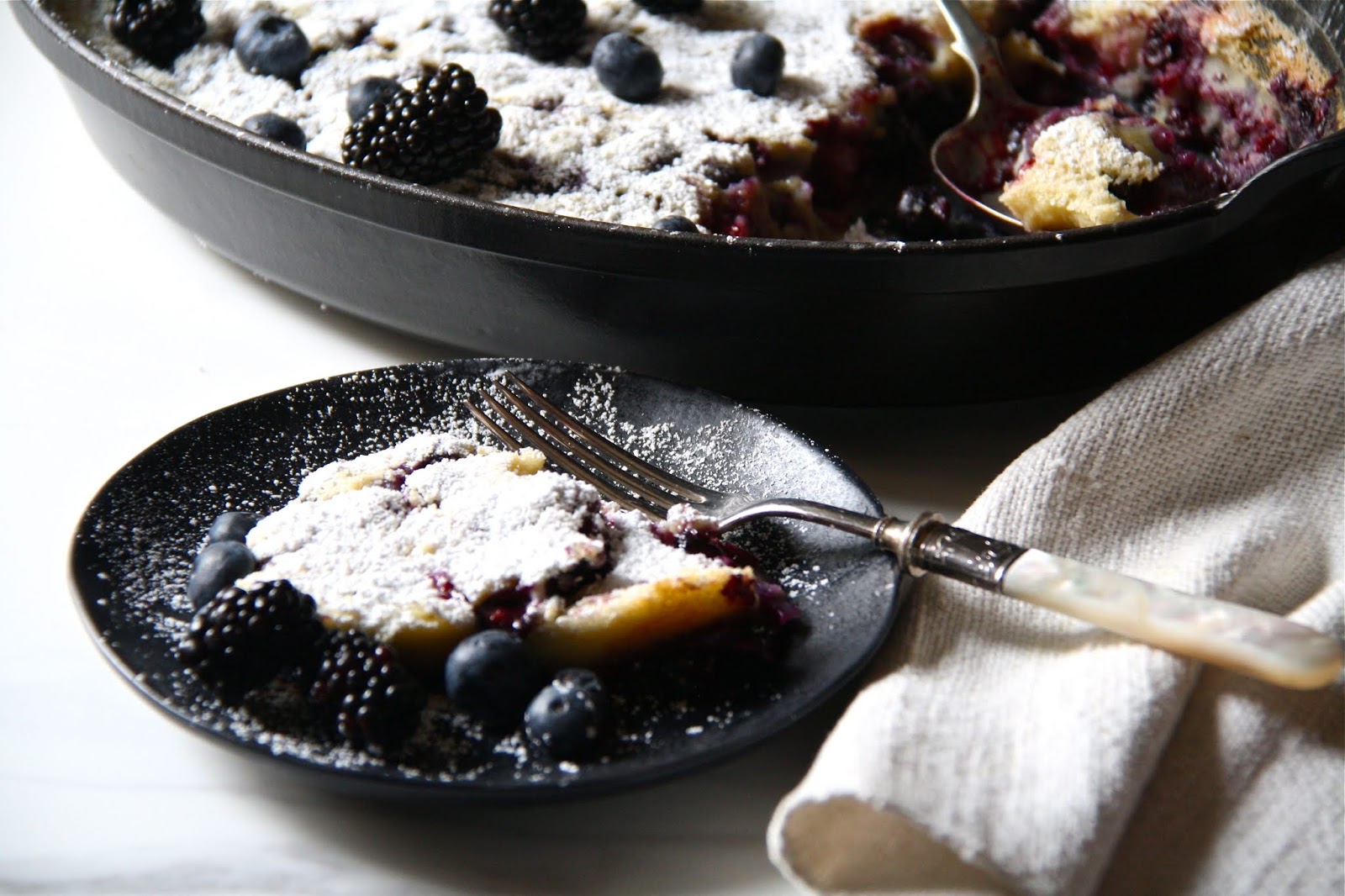
Black and Blue (berry) Clafoutis


There is a very long list of things I look forward to as summer starts to come an end and fall arrives. But my most anticipated BIG three are: (1) the release of movies most likely to be considered Oscar-worthy, (2) new book releases having compelling stories and/or written by some of my favorite authors, and (3) comfortably cool, low humidity days when the air-conditioning is turned off and the windows are finally opened again. Throw in fall apple picking season, the autumnal landscapes, crackling fires to take the chill off the day, and making homemade caramels again, and I get almost giddy just thinking about them. Much to my surprise, at least two of my favorite BIG three things, arrived early this year. While a shift in the weather wasn't one one of them, my Amazon book wishlist seems to grow almost daily and my consumption of movie theatre popcorn (a guilty pleasure) has increased significantly in the past couple of weeks. My preferences books and movies are somewhat similar in that they usually don't skew to the humor genre. I am more of a drama, fable, historical fiction, realistic fiction kind of girl. But after seeing the Rom-Com "Crazy Rich Asians" this past weekend, I may have to put humor back on the list. Have you seen that movie yet? OMG it is so-o-o-o-o crazy good, I almost want to see it again. You absolutely have to see it as there is more to this film than a love story. It might even be one of the contenders for the family Christmas movie this year. Fingers crossed it's out on DVD or available on demand when December rolls around.


As the glory days of summer come to an end, sadly so does the tomato, peach, and berry season. Which means I have to get my fix in for all of them before they have all but disappeared from the Farmer's Markets and grocery stores. At least overindulging in summer tomatoes, peaches and berries isn't such a bad thing. 

Four years ago I shared a recipe for a Cherry Clafoutis, a slight adaptation of a version shared by Williams-Sonoma. This time I am sharing a slightly altered version of Julia Child's recipe for this classic French custard-like textured dessert. Clafoutis, pronounced 'kla-FOO-tee' (or you can hear it spoken here), originates from the farming region of Limousin, France but didn't gained widespread popularity until the nineteenth century. The word clafoutis comes from the verb 'clafir' which means 'to fill'. Traditionally it is made with un-pitted cherries. Yes, unpitted. While not discounting the subtle almond flavor cherry pits give to the custard, today most Cherry Clafoutis are made with fresh pitted cherries. Seems risking someone choking on a cherry pit is considered slightly more important than a hint of almond flavor these days.


But Clafoutis purists might argue a clafoutis is not a clafoutis if it's made with anything other than cherries. Instead a clafoutis made with berries or any other fruit would be considered a flaugnarde. Although in her cookbook "Mastering the Art of French Cooking, Volume I", Julia Child refers to one made with blackberries or blueberries as "Clafouti aux Mures or Claufouti aux Myrtilles". Which means I feel safe calling this a Black and Blue (berry) Clafoutis.


With the creation of clafoutis being attributed to peasants and farmers, it is and is intended to be a simple dessert. How else would we consider a pancake batter poured over fruit and baked in an ovenproof dish anything else? Yet, as simple as it is to make, the mere presentation of a Clafoutis as a dessert makes it appear to be so much more.


The technique used here for assembling the clafoutis is different than one recommended by Julia Child. Instead of using a blender to whip up the custard's ingredients, I used a standing mixer with a whisk attachment. Additionally, I did not whip all of the custard ingredients at once. Using the technique from my Cherry Clafoutis recipe, I whipped the eggs and 1/3 cup of the sugar together for approximately four minutes (until they had almost tripled in volume) before adding in the flour, milk, cream, salt, and vanilla. With the exceptions of increasing the salt from 1/8 teaspoon to 1/4 teaspoon and using a milk/cream combination versus using milk only, I kept all of the other ingredient amounts the same as Julia's recipe. Well that's not completely true. I made one more ingredient exception. Instead of using 1 1/4 cups of all-purpose flour as she recommends for a clafoutis made with juicy, berry fruits, I used the 2/3 cup of flour amount from her Cherry Clafoutis recipe. After having made this Black and Blue (berry) Clafoutis I am not sure I would increase the amount of flour to the higher amount. Maybe I would use up to 3/4 cup of flour if the berries were overly ripe.


After buttering a heat proof dish (use an au gratin style or round pan), a quarter of the batter is poured into it. Instead of setting the pan over moderate heat on the stove top to allow the batter to develop a film, I placed the pan in a preheated 350 degree (F) oven for approximately 5 minutes. And then I sprinkled on the berries and the remaining 1/3 cup granulate sugar before pouring over the rest of the batter. 


The recommended baking time will range from 45 to 60 minutes, however, the size and depth of the pan will affect it. With the pan I used, my baking time was closer to the 45 minute mark.

A clafoutis is intended to be served warm, not hot. Once removed from the oven, it can sit for 5-10 minutes before it is finished with a dusting of confectionary sugar.

But even after we finished our first helping of the Black and Blue (berry) Clafoutis, it was still delicious at room temperature several hours later. 


If you, anyone in your family, or any of your friends are big fans of custard-textured desserts, you need to make this Black and Blue (berry) Clafoutis.


I used a combination of fresh blueberries and blackberries, but it would be equally delicious using one or the other. Don't let the summer berry season come to an end without making this Black and Blue (berry) Clafoutis because it wasn't intended to be with frozen berries. Bon Appetit!

Recipe
Black and Blue (berry) Clafoutis (several alterations to Julia Child's Berry Clafoutis recipe as shard in her cookbook 'Mastering the Art of French Cooking, Volume I')

Ingredients
2/3 cup (134g) granulated sugar, divided
3 large eggs
3/4 cup whole milk
1/2 cup heavy whipping cream
1 Tablespoon vanilla
1/4 teaspoon sea salt or kosher salt
2/3 cup (87g) all-purpose flour
14 ounces fresh berries (mixture of blackberries and blueberries or use only blackberries or blueberries) Note: Do not use frozen berries.
Confectionary sugar for dusting

Directions
1. Preheat oven to 350 degrees (F). Butter a 10" baking pan or dish with deep sides and set aside.
2. In the bowl of a standing mixer fitted with a whisk attachment beat 1/3 cup of the granulated sugar and the eggs until light, fluffy, and has more than tripled in volume (approximately 4 minutes).
3. Add in the milk, vanilla, sea salt, and flour. Mix on medium speed to blend.
4. Pour 1/4 of the batter into the prepared baking pan. Place in oven and bake for 5 minutes or until a film forms on the batter.
5. Remove from oven. Sprinkle the berries evenly over the partially set batter. Then sprinkle the remaining 1/3 cup of sugar over the berries. Pour remaining batter over the berries. 
6. Return pan to oven and continue to bake for 45-60 minutes or until sides are lightly golden and clafoutis is set in the middle. Note: Size of the baking pan will either increase or decrease baking time.
7. Allow to sit for 5-10 minutes before sprinkling with confectionary sugar. Serve immediately. Note: The clafoutis is best served warm but it is delicious at room temperature.

Notes: (1) Instead of using both whole milk and whipping cream, can use whole milk only. If using whole milk only use 1 1/4 cups. (2) Instead of blackberries and/or blueberries, could also use freshly pitted cherries. (3) Check for doneness at the 40 minute mark. Again, the size of the pan will affect baking time.

Sedona, Arizona (March 2016)